By Imran Mulla — Founder, TravelJunctions.in | Contributor, XploreHeaven.com
If you’re flying to India after April 1, 2026, there’s one new thing you absolutely cannot ignore — the India e-Arrival Card 2026. Miss it, and you could be standing in a long queue at the airport while everyone else walks through. I’ve spent 17 years moving groups in and out of India’s busiest airports, and I can tell you — the difference between a smooth immigration experience and a nightmare one is almost always preparation.
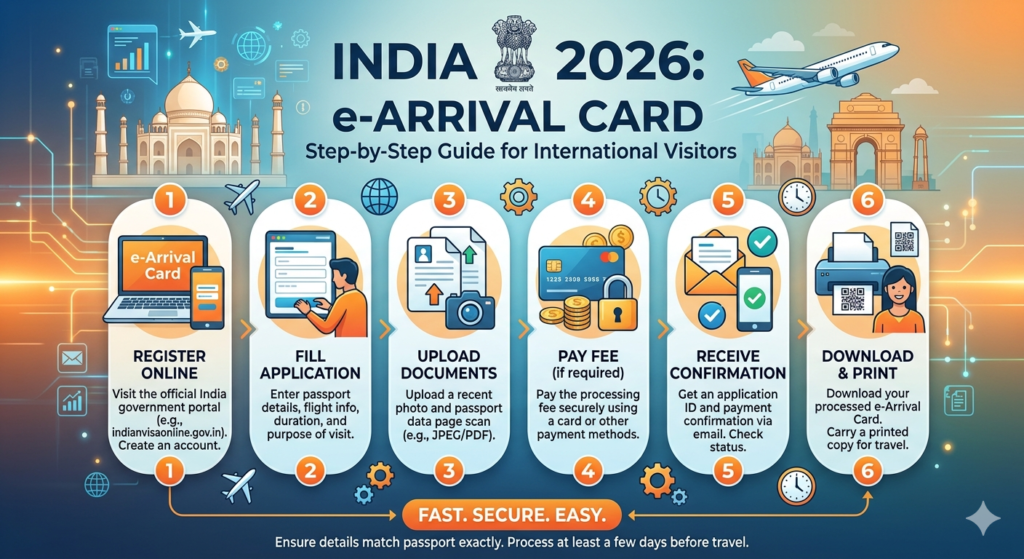
This guide gives you everything you need to fill the form right, submit it on time, and walk through immigration without stress.
🟦 Quick Answer Box — What Is the India e-Arrival Card?
The India e-Arrival Card is a free, mandatory digital form that all foreign nationals and OCI (Overseas Citizen of India) cardholders must submit within 72 hours before landing in India. It replaces the old paper disembarkation form that airlines used to hand out during flights. Once submitted, you get a QR code that immigration officers scan at the airport. It is not a visa — it is a separate arrival declaration form.
What Is the India e-Arrival Card 2026?
The India e-Arrival Card is a digital pre-arrival declaration system introduced by the Bureau of Immigration (BoI) under India’s Ministry of Home Affairs. It officially launched on October 1, 2025, during a transition period where both paper forms and the digital card were accepted side by side.
From April 1, 2026, the paper disembarkation form — the blue or white card that flight attendants used to hand out before landing — has been permanently discontinued at all Indian airports. The digital e-Arrival Card is now the only accepted method.
The form captures:
- Full name and passport details
- Flight number and port of entry
- Purpose of visit (tourism, business, study, medical, etc.)
- Address of stay in India (hotel or host’s address)
- Brief health declaration
After submission, the system generates a QR code. You show this QR code — on your phone screen or as a printout — to the immigration officer on arrival. They scan it, cross-check your details, and you’re good to go.
This is part of India’s larger IVFRT 3.0 (Immigration, Visa, Foreigners Registration and Tracking) modernisation programme, which is upgrading everything from border analytics to biometric e-gates at major airports.
Why Has India Made the e-Arrival Card Mandatory in 2026?
India was one of the last major tourism destinations still using paper disembarkation forms — a system largely unchanged since the 1960s. That changes now.
Here’s why the Ministry of Home Affairs pushed this reform:
- Faster immigration processing: Early data shows that the e-Arrival Card has already reduced average immigration wait times by up to 40% at Delhi, Mumbai, and Bengaluru airports.
- Stronger security: The digital form is time-stamped and cross-checked against visa records and watch-lists in real time. Paper forms were prone to errors, illegible handwriting, and data entry delays.
- Environmental savings: India processes over 48 million paper forms a year. Going digital saves an estimated ₹28 crore in printing and logistics costs annually.
- Global alignment: India is now joining countries like Singapore (SG Arrival Card), Thailand, Australia, Japan, and South Korea — all of which already use mandatory digital pre-arrival declarations.
What I’ve seen on the ground at Indira Gandhi International Airport (IGI/DEL) in Delhi is that even a small bottleneck at immigration can create cascading delays, especially during peak international arrival windows. Digital pre-clearance is genuinely the answer.
Who Needs to Fill the India e-Arrival Card 2026?
This catches a lot of people off guard — especially OCI cardholders who assumed they were exempt (more on that in a dedicated section below).
Traveler Type — Required or Not?
| Traveler Type | e-Arrival Card Required? |
|---|---|
| Foreign tourist (any country) | ✅ Yes |
| Business traveler (foreign national) | ✅ Yes |
| International student | ✅ Yes |
| Medical visitor | ✅ Yes |
| Transit passenger (clearing Indian immigration) | ✅ Yes |
| OCI (Overseas Citizen of India) cardholder | ✅ Yes (mandatory since Oct 4, 2025) |
| Foreign national on e-Visa | ✅ Yes |
| Foreign national on paper/regular visa | ✅ Yes |
| Airside transit (no immigration clearance) | ❌ Not required |
| Indian citizen (Indian passport) | ❌ Exempt |
Important: If you’re an Indian citizen traveling on an Indian passport, you do NOT need the e-Arrival Card. That’s the only exemption.
Is the India e-Arrival Card Different From an e-Visa?
Yes — and confusing these two is one of the most common mistakes I see travelers make. They are completely separate requirements.
| Feature | e-Arrival Card | e-Visa (Indian Visa) |
|---|---|---|
| Purpose | Arrival declaration form | Entry permission into India |
| Cost | Free | Paid (fees vary by category) |
| When to submit | Within 72 hours before arrival | Apply weeks in advance |
| Who issues it | Bureau of Immigration (BoI) | Bureau of Immigration (BoI) |
| Validity | Single trip | Varies (30 days, 1 year, 5 years) |
| Replaces | Paper disembarkation form | Embassy/consulate visa sticker |
| Required for OCI holders | ✅ Yes | ❌ No (OCI grants visa-free entry) |
| Portal | indianvisaonline.gov.in/earrival | indianvisaonline.gov.in/evisa |
The bottom line: Your e-Visa gets you into India. Your e-Arrival Card tells immigration exactly who you are when you land. Both are mandatory for most foreign travelers — they work together, not in place of each other.
When Should You Submit the India e-Arrival Card 2026?
The 72-hour window is strict. Here’s what that means in practice:
- You can submit the form no earlier than 72 hours (3 days) before your scheduled arrival in India.
- Forms submitted more than 72 hours in advance may be rejected by the system.
- Ideally, submit 24 to 48 hours before your flight — this gives you enough time to resolve any errors without panic.
💡 Best Time to Submit: Set a phone reminder for 2 days before your India arrival date. Open the form, have your passport and hotel booking ready, and complete the process in under 10 minutes. Don’t wait until you’re at the departure airport — public Wi-Fi is unreliable, and last-minute submissions cause unnecessary stress.
How to Fill the India e-Arrival Card 2026 — Step by Step
Step 1: Visit the Official Portal
Go to indianvisaonline.gov.in/earrival on any browser, or download the Su-Swagatam mobile app from the Google Play Store or Apple App Store.
⚠️ Warning: Scam websites are appearing on Google that charge fees (sometimes up to $160 USD) to fill this form. The e-Arrival Card is 100% free. Use ONLY the official government portal or the Su-Swagatam app. No third-party agent is needed.
Step 2: Enter Your Passport Details
Fill in the following:
- Full name (exactly as on your passport)
- Date of birth
- Nationality
- Passport number (triple-check this — wrong passport numbers are the #1 cause of delays)
- Passport issue date and expiry date
- Visa type, OR OCI card number (for OCI holders — enter both passport number and OCI card number)
Step 3: Enter Your Flight Information
- Flight number
- Port of entry (airport name — e.g., Indira Gandhi International Airport, Delhi)
- Scheduled date and time of arrival
Step 4: Add Your Indian Address
You must provide a specific address where you’ll be staying in India. “Hotel TBD” is not accepted. Use:
- Your hotel’s full address, OR
- A relative/friend’s home address
Book at least your first night’s accommodation before filling this form.
Step 5: Review and Submit
Review every field carefully. Corrections after submission are not possible. If you made an error, you may need to submit a new form, which can create a duplicate record — a headache at immigration.
Step 6: Download and Save Your QR Code
After submission, you’ll receive a QR code confirmation. This is critical:
- Download it immediately to your phone’s gallery.
- Email it to yourself as a backup.
- Take a screenshot of the QR code.
⚠️ If you close the browser without saving the QR code, you may not be able to retrieve it from the system. A duplicate submission can cause a flag at immigration.
What Documents Do You Need?
Before sitting down to fill the form, have these ready:
- ✅ Valid passport (at least 6 months validity from arrival date, with 2 blank pages)
- ✅ Valid Indian visa or e-Visa (or OCI card for OCI holders)
- ✅ Confirmed flight details (flight number, arrival date and time)
- ✅ Hotel booking or Indian address (full address required)
- ✅ Email address (for QR code delivery)
- ✅ Mobile number (for contact details)
- ✅ OCI card number (if applicable — required alongside passport number)
No document uploads are required. You don’t need to scan or attach anything — just key in the information.
What Happens at Indian Immigration After Submission?
Here’s the ground-level picture of what actually happens when you land — based on what I’ve witnessed across dozens of client arrivals at Indira Gandhi International Airport (DEL), Chhatrapati Shivaji Maharaj International Airport (BOM) in Mumbai, and Kempegowda International Airport (BLR) in Bengaluru.
- You join the immigration queue. Lanes are now segregating passengers who have the e-Arrival Card from those who don’t.
- You present your QR code — on your phone or as a printout — to the immigration officer.
- They scan the QR code. Your pre-filled details appear on their system immediately.
- Biometric verification — fingerprints and photo, standard for all foreign nationals.
- Passport stamp and clearance. The entire counter interaction can take as little as 2–3 minutes if your form is correctly filled.
What happens if you DON’T have the QR code? You’ll be directed to a staffed kiosk to fill the form manually on the spot. This takes longer and, depending on the time of day and airport traffic, could mean 30–60 extra minutes — enough to miss a domestic connecting flight.
Common Mistakes That Can Cause Airport Delays
In my experience helping travelers through Indian airports, these are the errors that cause the most trouble:
| Mistake | Consequence | Fix |
|---|---|---|
| Wrong passport number entered | System mismatch, immigration hold | Check passport number 3 times before submitting |
| Submitting too early (more than 72 hours before arrival) | Form rejected by system | Submit within the 72-hour window only |
| No saved QR code (closed browser early) | Cannot retrieve; must re-fill form | Screenshot and email QR code immediately after submission |
| Vague Indian address (“Hotel TBD”) | Form rejected | Book first night’s hotel before filling the form |
| Using a third-party paid website | Risk of scam and incorrect filing | Use only indianvisaonline.gov.in/earrival |
| Filling form on airport public Wi-Fi | Connection drops, session times out | Complete at home or hotel, on a stable connection |
| OCI holder skipping the form | Diverted to manual kiosk | OCI holders MUST fill the form — no exemption |
Can OCI Cardholders Skip the India e-Arrival Card 2026?
No. This is one of the most Googled questions on Reddit and travel forums right now, and the answer is clear: OCI cardholders cannot skip the e-Arrival Card.
Here’s the timeline that caused the confusion:
- October 1, 2025: The e-Arrival Card launched. OCI cardholders were initially announced as exempt.
- October 4, 2025: Just 3 days later, the Bureau of Immigration reversed that decision. OCI cardholders were added to the mandatory requirement.
- April 1, 2026: Full enforcement began for everyone.
OCI holders who have traveled to India many times and were previously waved through without any arrival form now need to submit the e-Arrival Card every single trip. The portal and 72-hour window are the same as for all other foreign nationals. When filling the form, OCI holders select “OCI Card” as their entry document and enter their OCI card number alongside passport details.
Best Tips to Avoid Immigration Delays in India
After 17 years of operating tours and seeing what goes wrong at immigration — here’s what actually works:
- Submit 24–48 hours before your flight. Not 10 minutes before boarding. Give yourself a buffer.
- Carry an offline screenshot of your QR code. Don’t rely on downloading it at the airport — Wi-Fi can be weak or blocked in certain zones.
- Never use public airport Wi-Fi to submit the form. Use your home network or a personal mobile hotspot.
- Book at least your first night’s accommodation before filling the form. You need a real address for the form.
- For families, use the “Add Member” feature to submit forms for all travelers in one go — saves time.
- Print a backup QR code. If your phone battery dies on a long-haul flight, a paper printout saves the day.
- Check for a yellow fever certificate if you’re traveling from an affected country — immigration can ask for it separately.
- For more destination-specific planning, check the XploreHeaven travel guides and Delhi airport guides for practical airport navigation advice.
Which Indian Airports Currently Support the System?
The e-Arrival Card system is active and enforced at all major international ports of entry:
| Airport | IATA Code | Enforcement Status |
|---|---|---|
| Indira Gandhi International Airport, New Delhi | DEL | ✅ Fully enforced from April 1, 2026 |
| Chhatrapati Shivaji Maharaj International Airport, Mumbai | BOM | ✅ Fully enforced from April 1, 2026 |
| Kempegowda International Airport, Bengaluru | BLR | ✅ Fully enforced from April 1, 2026 |
| Chennai International Airport | MAA | ✅ Active |
| Netaji Subhas Chandra Bose International Airport, Kolkata | CCU | ✅ Active |
| Rajiv Gandhi International Airport, Hyderabad | HYD | ✅ Active |
| Cochin International Airport, Kerala | COK | ✅ Active |
| Sardar Vallabhbhai Patel International Airport, Ahmedabad | AMD | ✅ Active |
The system also applies at seaports and land border immigration crossings where international travelers clear Indian immigration.
India e-Arrival Card 2026 — FAQs
Q1. Is the India e-Arrival Card free?
Yes, completely free. There is no fee at any stage. Any website or agent charging a fee for this service is a scam. Use only indianvisaonline.gov.in/earrival or the Su-Swagatam app.
Q2. Can I edit the form after submitting?
No. Once submitted, corrections cannot be made. Review every detail carefully before hitting submit. If you made a serious error, you may need to file a new form — which can create a duplicate record and cause a flag at immigration.
Q3. Do children need to fill the India e-Arrival Card?
Yes. Every foreign national — including minors — requires an e-Arrival Card. Parents can use the “Add Member” feature to include children under one submission.
Q4. What if the official portal crashes when I try to submit?
Try the Su-Swagatam mobile app as an alternative. If both are down, attempt again after a few hours. Don’t leave this until the last hour before your flight — this is exactly why submitting 24–48 hours in advance is recommended. If you arrive without a QR code due to a genuine technical outage, explain the situation to the immigration officer; exceptions can be made in documented cases.
Q5. Does the e-Arrival Card replace my Indian visa?
No. They are separate. The e-Arrival Card is an arrival declaration. Your Indian visa (or e-Visa, or OCI card) grants you entry permission. Both are required.
Q6. How long does the form take to fill?
Most travelers complete it in 5–10 minutes if documents are ready. No uploads required — just data entry.
Q7. What if my flight is delayed or I miss my flight after submitting?
Your e-Arrival Card is tied to your scheduled arrival. If your flight significantly changes, it is advisable to submit a fresh form with updated flight details within the new 72-hour window before your revised arrival time.
Q8. Is the e-Arrival Card required for transit passengers?
Only if you clear Indian immigration. If you remain in the international airside transit zone without passing through immigration, you do not need it. If your transit involves exiting the transit area (for example, different airline tickets or overnight stay), you do need it.
Q9. Can I submit the form on behalf of someone else?
Yes. A travel agent, family member, or employer can fill the form with the traveler’s details. The QR code is for the traveler to present at immigration.
Q10. What if I’m from a visa-exempt country or entering on a Visa on Arrival?
The e-Arrival Card is still required regardless of your visa type, visa exemption status, or Visa on Arrival eligibility. It is a separate declaration from visa permissions.
Q11. Can I use a printout of the QR code instead of showing it on my phone? Yes. A printed copy is fully acceptable and actually recommended as a backup for long flights where your phone may run out of battery.
Q12. Will airlines check for the e-Arrival Card before boarding? Yes. Airlines have been instructed to enforce a “no form, no boarding” rule. Most major carriers — including Air India, Emirates, British Airways, Lufthansa, and Singapore Airlines — now check for the e-Arrival Card at check-in or at the boarding gate.
A Final Word from Imran Mulla
India’s shift to a digital arrival system is genuinely good news for international travelers — once you understand how it works. What I’ve seen over 17 years in this industry is that confusion at immigration is almost never about complicated rules; it’s about people being caught off guard. The e-Arrival Card takes under 10 minutes, costs nothing, and can save you an hour of airport frustration.
The future of travel into India is digital — biometric e-gates, AI-powered passenger analytics, and seamless border crossings are already in the pipeline. The e-Arrival Card is step one of that journey.
Submit your form early, save your QR code offline, and walk through immigration with confidence. India is waiting — and it’s one of the most extraordinary destinations on earth.
Safe travels.
— Imran Mulla, Founder — TravelJunctions.in
📌 References & Citations
This article is backed by authoritative sources. The research, facts, dates, and data presented here have been verified against the following official and credible references:
- Bureau of Immigration, Ministry of Home Affairs — Official e-Arrival Card Portal https://indianvisaonline.gov.in/earrival/
- BusinessToday — “India makes e-Arrival Card mandatory for international travellers” (April 3, 2026) https://www.businesstoday.in/india/story/india-makes-e-arrival-card-mandatory-for-international-travellers-what-you-need-to-know-523849-2026-04-03
- VisaHQ — “India Introduces Mandatory Digital e-Arrival Card for All Foreign Travelers from 1 April 2026” https://www.visahq.com/news/2026-03-31/in/india-introduces-mandatory-digital-e-arrival-card-for-all-foreign-travelers-from-1-april-2026/
- VisaHQ — “India Finalises Full Roll-Out of Mandatory e-Arrival Card” (April 4, 2026) https://www.visahq.com/news/2026-04-04/in/india-finalises-full-roll-out-of-mandatory-e-arrival-card-for-all-international-passengers/
- Republic World — “India’s New Travel Rule from April 1, 2026: E-Arrival Card Mandatory for Foreign Visitors” https://www.republicworld.com/india/india-to-mandate-e-arrival-card-for-foreign-travelers-starting-april-1-2026-who-must-fill-it-what-happens-if-you-skip-and-key-details
- VisaVerge — “India e-Arrival Card for OCI Holders: Requirements & March 2026 Deadline” https://www.visaverge.com/immigration/oci-holders-are-exempt-from-new-e-arrival-card-on-india-landings/
- TravelTourister — “India e-Arrival Card 2026: US, UK, Canada & Australia Guide” (April 4, 2026) https://www.traveltourister.com/news/india-e-arrival-card-mandatory-april-2026-us-uk-canada-australia-guide/
- Envoy Global — “India e-Arrival Card for All Foreign Nationals Within 72 Hours Before Arrival” https://www.envoyglobal.com/news-alert/india-e-arrival-card-for-all-foreign-nationals-within-72-hours-before-arrival/
- Indian Eagle — “How to Obtain India’s e-Arrival Card Mandatory from April 2026” https://www.indianeagle.com/travelbeats/all-about-india-digital-earrival-card-for-foreigners/
- NRI Information — “India’s e-Arrival Card — mandatory from 1 October 2025” https://nriinformation.com/visa-oci/arrival-card-india
- e-Arrival Card India (Official Guide) — Step-by-Step Instructions https://e-arrival-card-india.com/
- Visa Traveler — “How to fill India e-Arrival Card: A step-by-step guide” https://www.visatraveler.com/visa/india-e-arrival-card/