
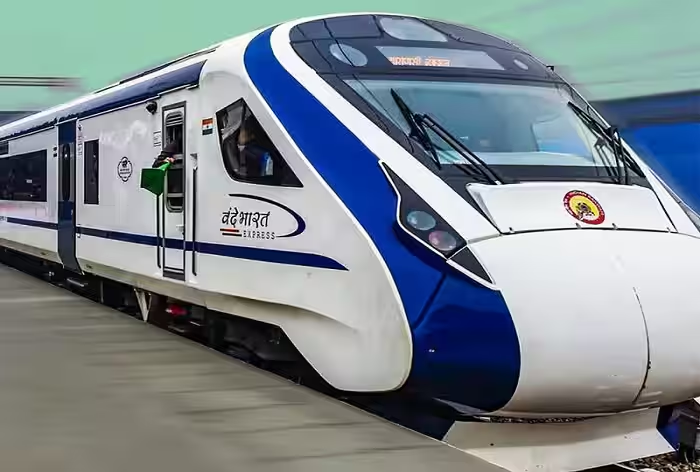
Vande Bharat Train 2026: Routes, Ticket Price, Speed & Is It Worth It?
I have been in the travel business for 20 years. I have seen passengers hunt for sleeper berths at 2 AM, fight over Tatkal quotas, and still arrive 4 hours late sweating through their shirts. So when Vande Bharat trains started rolling out across India, I paid attention. Not because the government told me to. But because my clients started asking — “Wahid bhai, should I book Vande Bharat or just fly?” That question alone tells you how much things have changed. In 2026, the Vande Bharat Express is no longer just a prestige project. It is a functioning, expanding network of semi-high-speed trains that is genuinely reshaping how urban India travels. Whether you are a working professional rushing between metros, a family heading to a pilgrimage site, or a weekend traveller chasing the mountains — this guide is for you. Let’s break it all down. Honestly. 🚆 What is Vande Bharat Train? Vande Bharat Express is India’s first indigenously designed semi-high-speed, modern train system operated by Indian Railways. It is a fully air-conditioned, self-propelled electric multiple unit (EMU) train built under the Make in India initiative by the Integral Coach Factory (ICF) in Chennai. Unlike older trains that depend on a single locomotive at the front, Vande Bharat distributes its motors across multiple coaches. This gives it faster pick-up speed, smoother braking, and quicker overall travel times. It connects cities up to 800 km apart, making it ideal for same-day and short overnight trips. 🌟 Why is Vande Bharat Train So Popular in India? Simple. It hits the sweet spot between speed, comfort, and national pride. When the first service ran between New Delhi and Varanasi in February 2019, people were genuinely surprised. The train was clean. The seats were good. It felt… different. Not like the trains most of us grew up with. Here is why passengers keep choosing it: The government has set an ambitious target of 4,500 Vande Bharat trains by 2047. That is a bold number — but the momentum is real. 🗺️ Vande Bharat Train Routes (Updated 2026 List) As of April 2026, 79 Vande Bharat trains are in active service across 82+ routes, covering 274+ districts and 16 railway zones. Here is a regional breakdown of key routes: 🏙️ North India Route Distance Approx. Travel Time New Delhi – Varanasi 759 km ~8 hrs New Delhi – Katra (Vaishno Devi) 655 km ~8 hrs New Delhi – Ajmer 441 km ~6 hrs New Delhi – Dehradun 314 km ~4.5 hrs Rani Kamalapati – Hazrat Nizamuddin 696 km ~7.5 hrs New Delhi – Patna 1,000 km ~12 hrs (longest chair car route) 🌴 South India Route Distance Approx. Travel Time Chennai – Bengaluru 362 km ~5 hrs Chennai – Coimbatore 497 km ~6.5 hrs Mysuru – Chennai Central 491 km ~6 hrs Mangalore – Thiruvananthapuram 575 km ~8 hrs Secunderabad – Visakhapatnam 716 km ~8.5 hrs Tirunelveli – Chennai Egmore 630 km ~7.5 hrs 🌊 West India Route Distance Approx. Travel Time Mumbai Central – Gandhinagar 522 km ~6.5 hrs Mumbai – Shirdi 296 km ~5 hrs Jodhpur – Sabarmati 476 km ~7 hrs Udaipur – Ahmedabad (Asarva) ~260 km ~4 hrs 🏔️ East India Route Distance Approx. Travel Time Howrah – New Jalpaiguri 564 km ~7.5 hrs Patna – Howrah 532 km ~6.5 hrs Nagpur – Bilaspur 295 km ~4 hrs Howrah – Kamakhya (Sleeper) ~460 km ~6 hrs 📌 Pro Tip: Always verify current routes on IRCTC’s official website as new services are being added regularly. ⚡ What is the Speed of Vande Bharat Train? Here is where I need to be straight with you — because a lot of travel content online hypes this up unfairly. Design Speed vs. Reality: Parameter Speed Trial / Design Speed Up to 183 km/h Maximum Operational Speed 160 km/h Average Speed (Most Routes) 100–130 km/h Average Speed on Best Corridors ~130–140 km/h The 160 km/h top operational speed is currently achieved on select sections — notably the Rani Kamalapati–Hazrat Nizamuddin service on the Tughlakabad–Agra stretch. On most other routes? The train runs between 100–130 km/h. Why? Because India’s rail infrastructure is still catching up. Curves, older signals, level crossings, and shared tracks with slow-moving freight trains all act as speed limiters. The honest verdict: Vande Bharat is significantly faster than most conventional trains, but it is not a bullet train. It saves you time — just not always as dramatically as the marketing suggests. On a route like Mumbai–Shirdi or Delhi–Agra, the time savings are very real. On longer routes with more stops, results vary. 💰 Vande Bharat Train Ticket Price (2026 Updated) This is the question I get asked most often. Here is the current fare structure: Chair Car (CC) vs Executive Chair Car (EC) Class Fare Range Best For Chair Car (CC) ₹700 – ₹1,800 Budget-conscious travellers, short to medium routes Executive Chair Car (EC) ₹1,300 – ₹3,200 Business travellers, long routes, those wanting premium comfort Route-Wise Sample Fares (2026) Route CC Fare EC Fare Delhi – Varanasi ~₹1,605 ~₹2,995 Delhi – Katra ~₹1,570 ~₹2,875 Mumbai – Gandhinagar ~₹1,125 ~₹2,095 Chennai – Bengaluru ~₹1,075 ~₹2,020 Howrah – NJP ~₹920 ~₹1,750 Vande Bharat Sleeper Class (2026 — Howrah–Kamakhya Route) Class Estimated One-Way Fare 3AC (AC 3 Tier) ~₹2,435 2AC (AC 2 Tier) ~₹3,145 1AC (First Class AC) ~₹3,855 Sleeper fares are based on Railway Board Circular No. CC 03/2026. Final prices may vary. 💡 Per-Kilometre Cost Insight At roughly ₹2.2 – ₹3.5 per km in Chair Car, Vande Bharat costs more than Shatabdi but less than most budget airlines on a per-km basis. For distances under 600 km, it often beats flights on total door-to-door cost when you factor in cab fares to the airport, check-in time, and luggage charges. Important: Unlike Rajdhani and Shatabdi, Vande Bharat uses fixed pricing — no dynamic surge pricing in Chair Car class. What you see is what you pay. 📲 How to Book Vande Bharat Train Tickets (Step-by-Step Guide) Booking via IRCTC is the most reliable
Vande Bharat Train 2026: Routes, Ticket Price, Speed & Is It Worth It? Read More »